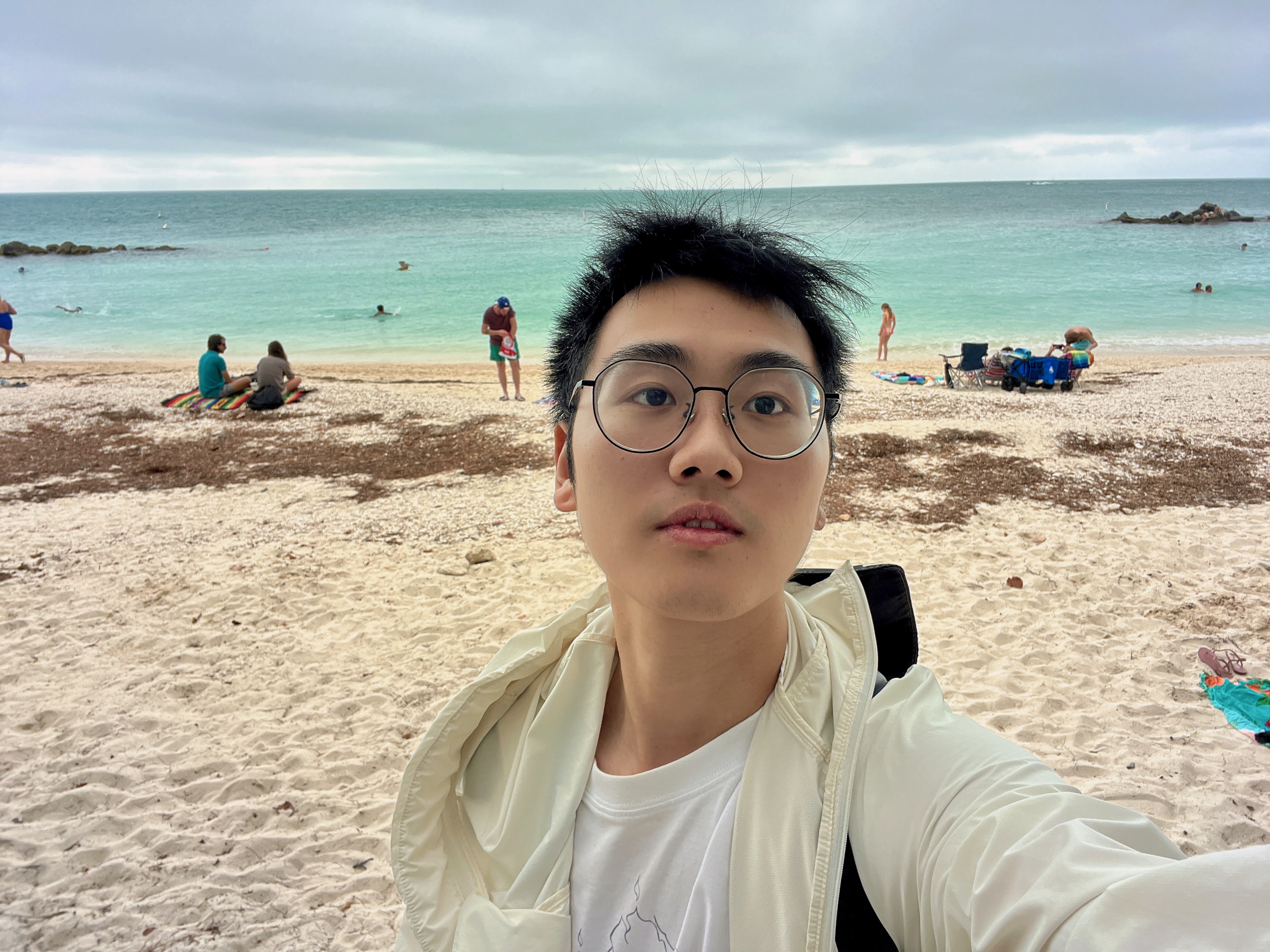
I’m currently a PhD student in the NCSU Systems Lab department of Computer Science at NC State University advised by Prof. Frank Mueller. Prior to that, I earned my Master degree at Wuhan National Laboratory for Optoelectronics (WNLO) at Huazhong University of Science and Technology (HUST) under the supervise of Prof. Ke Zhou. And I receive my Bacholar degree at Hainan University.
My Research interest mainly focused on the System Architecture, High Performance Computer and Storage techniques (e.g. Persistent Memory and CXL memory).
🌎 Motto
- 读万卷书 行万里路
- Gain wisdom through reading and broaden horizons through travel.
🔥 News
- 2025.12: 🏆 Our work FitCache has been accepted to IPDPS 2026. See you in New Orleans!
- 2025.10: 🎉 Passed the PhD Written Preliminary Exam. Thanks to everyone for the support!
- 2024.10: 🏆 Poster accepted at SC 2024. Looking forward to presenting in Atlanta.
- 2023.08: 🎓 Started my PhD journey at NC State University!
📖 Educations
-
08/2023 – Present, North Carolina State University, Raleigh, USA
Ph.D. candidate in Computer Science (Advisor: Prof. Frank Mueller) - 09/2019 – 06/2023, Huazhong University of Science and Technology, Wuhan, China
M.Sc. in Computer System Architecture- Thesis: Research on Performance Anomaly Detection and Root Cause Analysis for Storage Systems in Data Centers
- Advisor: Prof. Ke Zhou
- Focus: Data Center, Storage System, Anomaly Detection, Root Cause Analysis, Machine Learning
- 09/2015 – 06/2019, Hainan University, Haikou, China
B.Eng. in Computer Science and Technology
📝 Publications
* These authors contributed equally to this work.
-
Guangxing Hu, Awais Khan, Christopher zimmer, Michael Brim, Frank Mueller.
“FitCache: A Transparent Drop-In Framework for Multi-Tier Caching to Accelerate Distributed Deep Learning Workloads.”
IPDPS 2026, New Orleans, USA. -
Guangxing Hu, Awais Khan, Frank Mueller.
“A Zero-Copy Storage with Metadata-Driven File Management Using Persistent Memory.”
SC Poster, 2024, Atlanta, USA. -
Yu Liu, Yunchuan Guan, Tianming Jiang, Ke Zhou, Hua Wang, Guangxing Hu, Ji Zhang, Wei Fang, Zhuo Cheng, Ping Huang.
“SPAE: Lifelong Disk Failure Prediction via End-to-End GAN-based Anomaly Detection with Ensemble Update.”
Future Generation Computer Systems, 2023. -
Yanzhao Xie*, Guangxing Hu*, Yu Liu, Zhiqiu Lin, Ke Zhou, Yuhong Zhao.
“How Visual Chirality Affects the Performance of Image Hashing.”
Neural Computing and Applications, 2022. -
Yangtao Wang, Yanzhao Xie, Lisheng Fan, Guangxing Hu.
“STMG: Swin transformer for multi-label image recognition with graph convolution network.”
Neural Computing and Applications, 2021.
🎖 Honors and Awards
- National Grand Prize of Massive Storage Algorithm Competition 2023
- Academic Scholarship of Huazhong University of Science and Technology 2019–2022
- Grand Prize, Group Programming Ladder Tournament, China Collegiate Computing Contest 2018
- The Principal Scholarships of Hainan University (Top 2%) 2018
💻 Internships
-
2025.06 - 2025.08, Oak Ridge National Laboratory (ORNL), Oak Ridge, TN, USA.
Designed FitCache, a multi-tier caching system for accelerating deep learning training. Implemented coordinated caching across memory and storage tiers to reduce data access latency, and evaluated the system at world-leading supercomputer Frontier. This work was presented at IPDPS 2026. -
2024.06 - 2024.08, Oak Ridge National Laboratory (ORNL), Oak Ridge, TN, USA.
Extended the HVAC deep learning caching framework with a Persistent Memory–based cache tier, enabling zero-copy access via DAX. Deployed and debugged the system on Frontier and ARC clusters, addressing MPI and runtime issues across environments. Achieved preliminary I/O performance improvements and presented the work in an SC 2024 poster.
💬 Talks
- 2025.08, Leveraging Memory Hierarchies for Scalable Caching in Deep Learning I/O on HPC Systems, Oak Ridge, TN, USA.
🔖 Projects

DPUBridge
A layered bridge that enables a DPU to read local host memory through GVMI aliasing and mirror payloads to a remote DPU using RDMA. The design separates control plane metadata exchange from data plane transfers to keep modules testable and clean.

FitCache
Transparent drop in framework that intercepts POSIX reads and serves training data from the fastest tier among memory, NVMe, and PFS via concurrent fetch.
- LD_PRELOAD client intercepts open read close and forwards requests to a cache server
- Hierarchical cache across DRAM or PMem and NVMe above Lustre or BeeGFS
- Concurrent multi tier fetch returns the earliest responder, tolerating tier variability
- Scaled evaluation on Frontier up to 2048 GPUs and smaller clusters

Visual Chirality in Image Hashing
This project studies visual chirality, where flipping an image can change its semantics and shift the hash code distribution, which can hurt retrieval when flip augmentation is used.
- Designed a ResNet 50 based classifier to identify images with chiral cues by comparing predictions of original and flipped images
- Constructed chiral datasets with controlled proportions of chiral images on VOC2007, MS-COCO, and NUS-WIDE
- Evaluated three representative hashing pipelines: HashNet, DCH, and BYOL plus DCH under multiple hash code lengths
- Provided visual explanations via activated region comparisons between original and flipped images